Teacher Resume Examples for Every Level and Subject
Teacher resume examples from kindergarten to university, plus ESL, substitute, and teaching-assistant samples, a copyable template, and the skills to list.
Canonical: https://qa.prezumi.com/blog/teacher-resume-examples
A strong teacher resume proves two things quickly: that you hold the right license to teach your grade and subject, and that students learn more because you're in the room. Hiring in education runs certification-first — many public-school applications are screened for a specific license and grade band early in the process, so your credentials belong near the top of the page, not buried at the bottom. Below are teacher resume examples for every level, from kindergarten to university, each linked to a live sample you can open, plus the skills, sections, and numbers that move a resume past an applicant tracking system and onto a hiring committee's shortlist.
The examples come first, then a text template you can copy, then the writing advice behind all of them — certifications, quantified results, a strong summary, and the keywords a district's hiring software looks for. The general rules that apply to any resume, teaching or not, are collected in our resume writing guide; this page is the teacher-specific version.
How these examples were made. Each résumé below is a real Prezumi template rendered from a complete teacher profile — the same builder you'd use for your own — not a static mock-up. The names and numbers are illustrative. The certification, ATS, and salary guidance reflects how U.S. public-school hiring commonly works; conventions differ by state and country, so check your local requirements before you copy anything wholesale.
Teacher resume examples by level and subject
Teaching is not one job. A kindergarten teacher and a university lecturer share a profession and almost nothing else about their day, and their resumes should look as different as their classrooms do. Each example below is a real resume rendered in a clean, ATS-friendly Prezumi template — so you can see the exact format for your grade band or role and then build your own from the same structure. Click any example to enlarge it, or use it as your starter profile with one tap.
Kindergarten and early-childhood teacher (entry level)
Early-childhood teaching is built on play-based learning, not lectures, and the resume should reflect that. This one leads with an early-childhood or PreK–3 certification and student-teaching placements, then shows the daily work that matters at this age: teaching early literacy and numeracy through centers and songs, building classroom routines that four- and five-year-olds can actually follow, tracking social-emotional milestones, and keeping parents informed through a child's first year of school. Where an older grade's resume quantifies test scores, this one shows readiness gains — how many students hit their early-literacy benchmarks by spring.
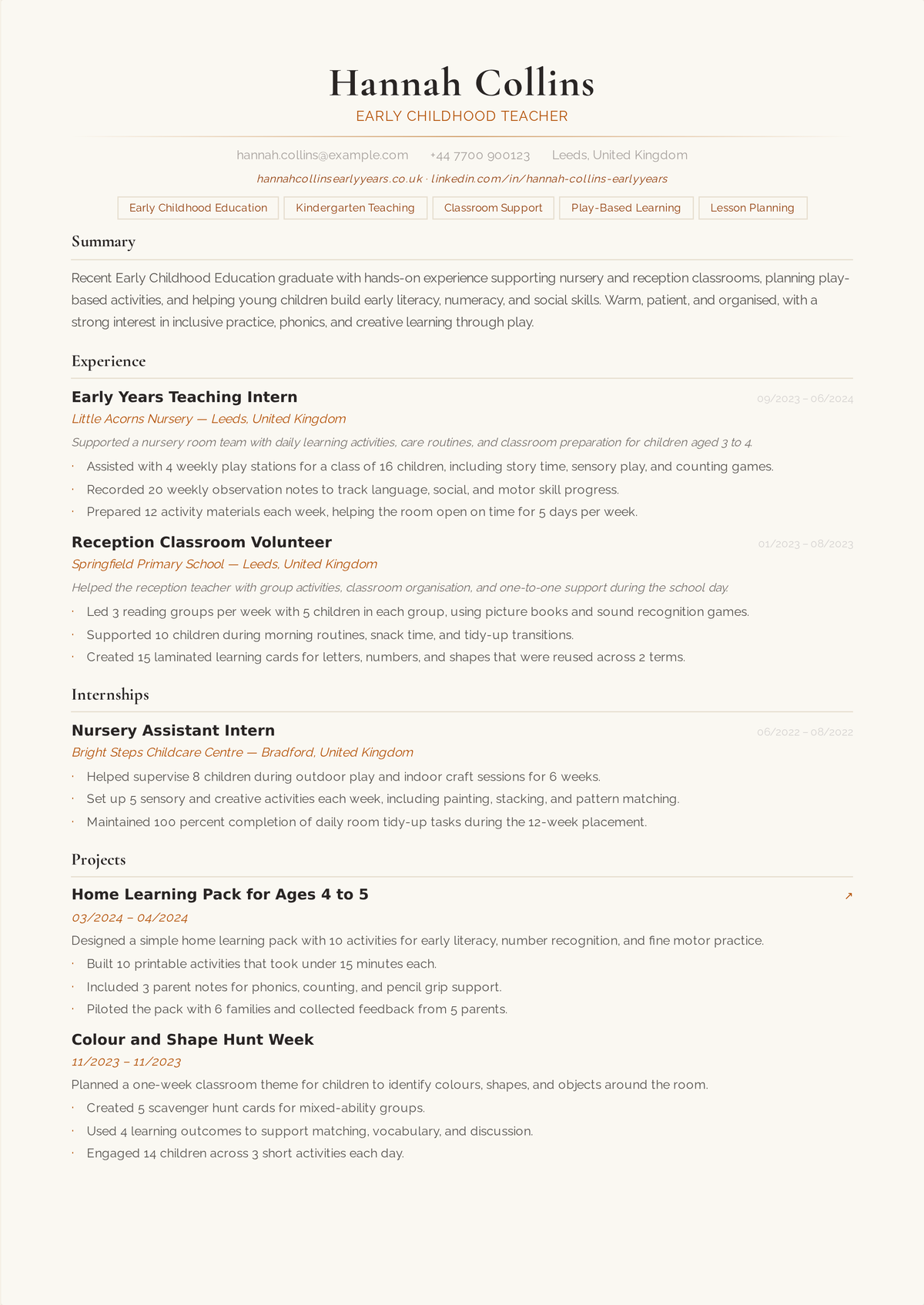
Why this resume works
- The early-childhood credential and a warm, play-based summary sit in the first three lines, so the fit is obvious before a principal scrolls.
- Every classroom line carries a number: 16 children, 4 daily play stations, 20 observation notes a week, instead of vague duties.
- Internships, a reception-class volunteering stint, and a home-learning project stand in for a thin work history, which is exactly right for a first teaching job.
- It names the routines districts screen for: phonics, observation and assessment, lesson planning, and classroom support.
Elementary (K–5) teacher (entry level)
An elementary teacher is a generalist who teaches one class every subject, so this resume has to show range: guided-reading groups, hands-on math and science, and the differentiated instruction that keeps a single classroom of 25 mixed-ability readers moving together. It also shows behavior management and standardized-test preparation, because K–5 is where state testing begins. The strongest bullets here name a number — reading levels raised, or the share of the class meeting grade-level standards.
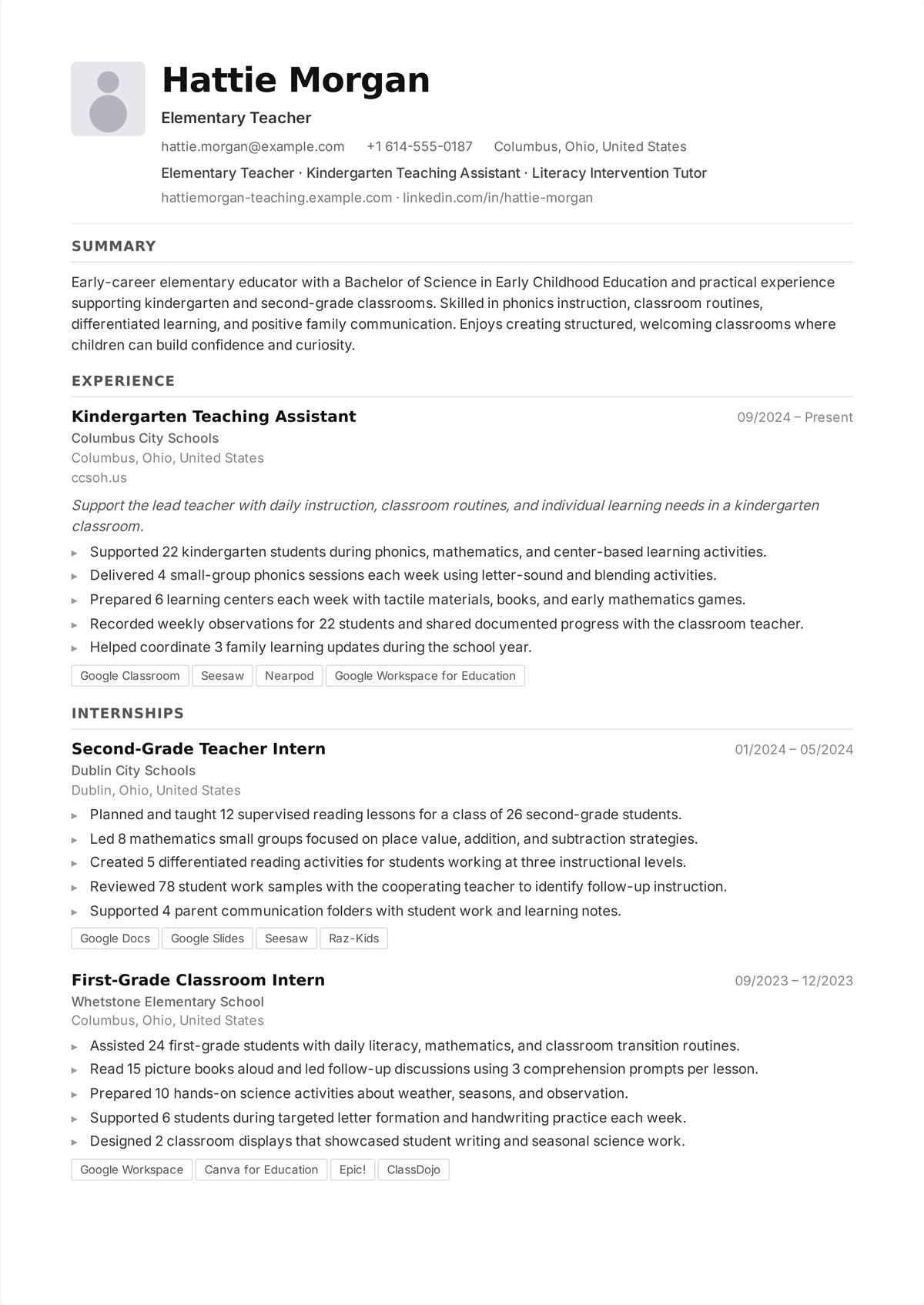
Why this resume works
- State certification and the K-5 grade band lead the page, the hard gate every elementary posting checks first.
- It reads as a generalist: reading, math, and classroom management shown side by side, because an elementary teacher teaches the whole day.
- Duties become outcomes, with reading levels, attendance, and parent-contact rates written as real percentages rather than "responsible for."
- It reuses the wording from the district's own posting — the terms an applicant tracking system often filters or ranks on — so it reads as a match, not a synonym.
Secondary subject teacher (entry level)
A secondary teacher goes deep in one subject across several class periods a day. This resume foregrounds a single-subject certification — English, history, biology — and the work that comes with 120-plus students on a roster: planning lessons to state standards, grading essays or problem sets at volume, and running a classroom of teenagers. Subject depth and evidence that you can manage the load are what a department head scans for first.
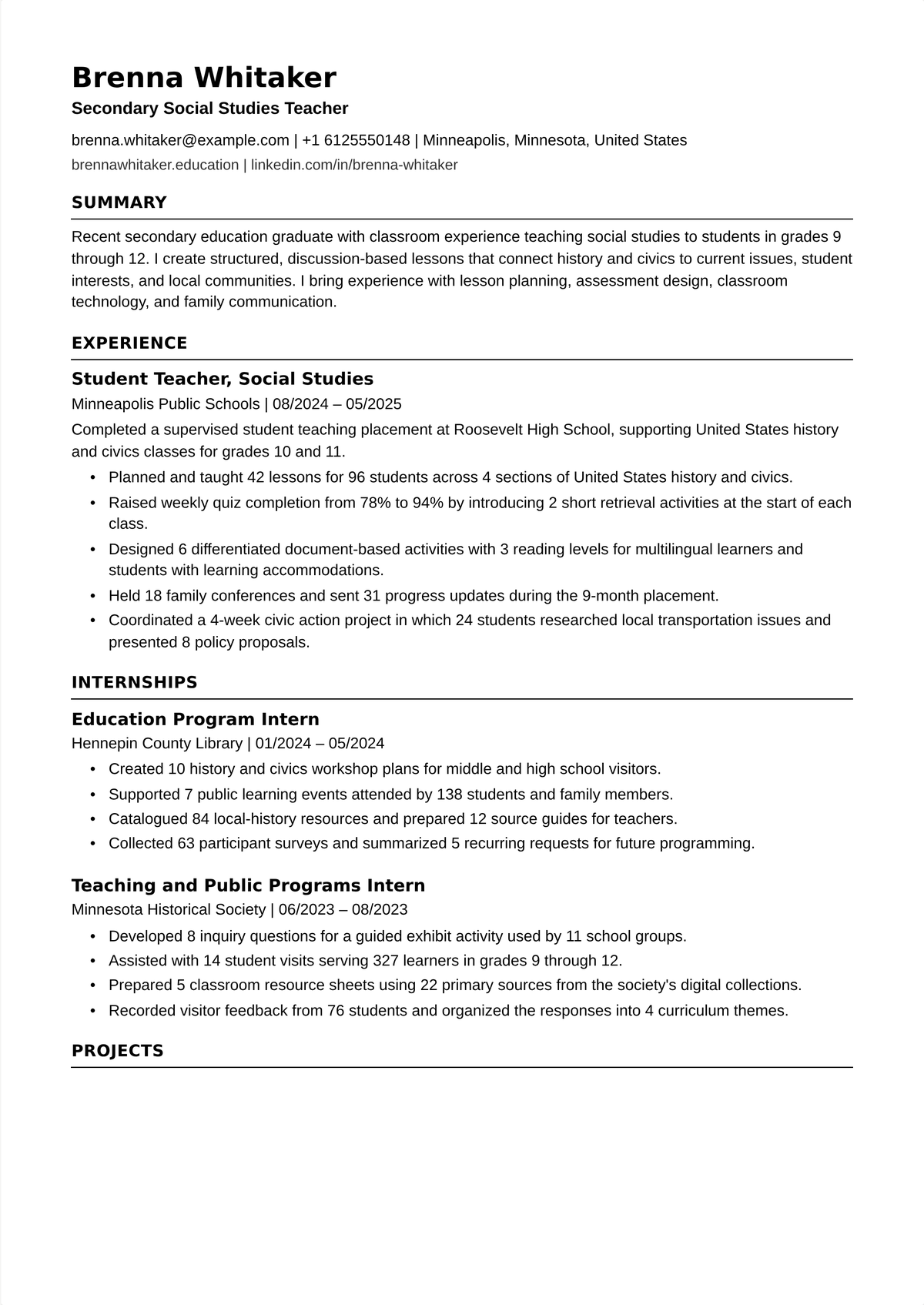
Why this resume works
- The single-subject certification and endorsement are front and center, which is what a department head scans for first.
- It shows the load a secondary teacher actually carries: multiple sections, a 100-plus student roster, and lessons planned to state standards.
- It backs "can teach" with numbers: pass rates, assignment completion, and students moved up a grade boundary.
- Student teaching and tutoring fill the experience side when full-time years are still short.
High-school subject teacher (mid-career)
A few years in, a subject teacher's resume shifts from "can teach" to "gets results." Whether the subject is English, math, physics, or history, this one leads with the subject certification and then proves impact: mock and exam-score gains, honors and AP pass rates, intervention that moved a specific group of students, and curriculum the teacher built rather than inherited. Mid-career resumes also start to show leadership, like mentoring a new teacher or running a department's data meetings.
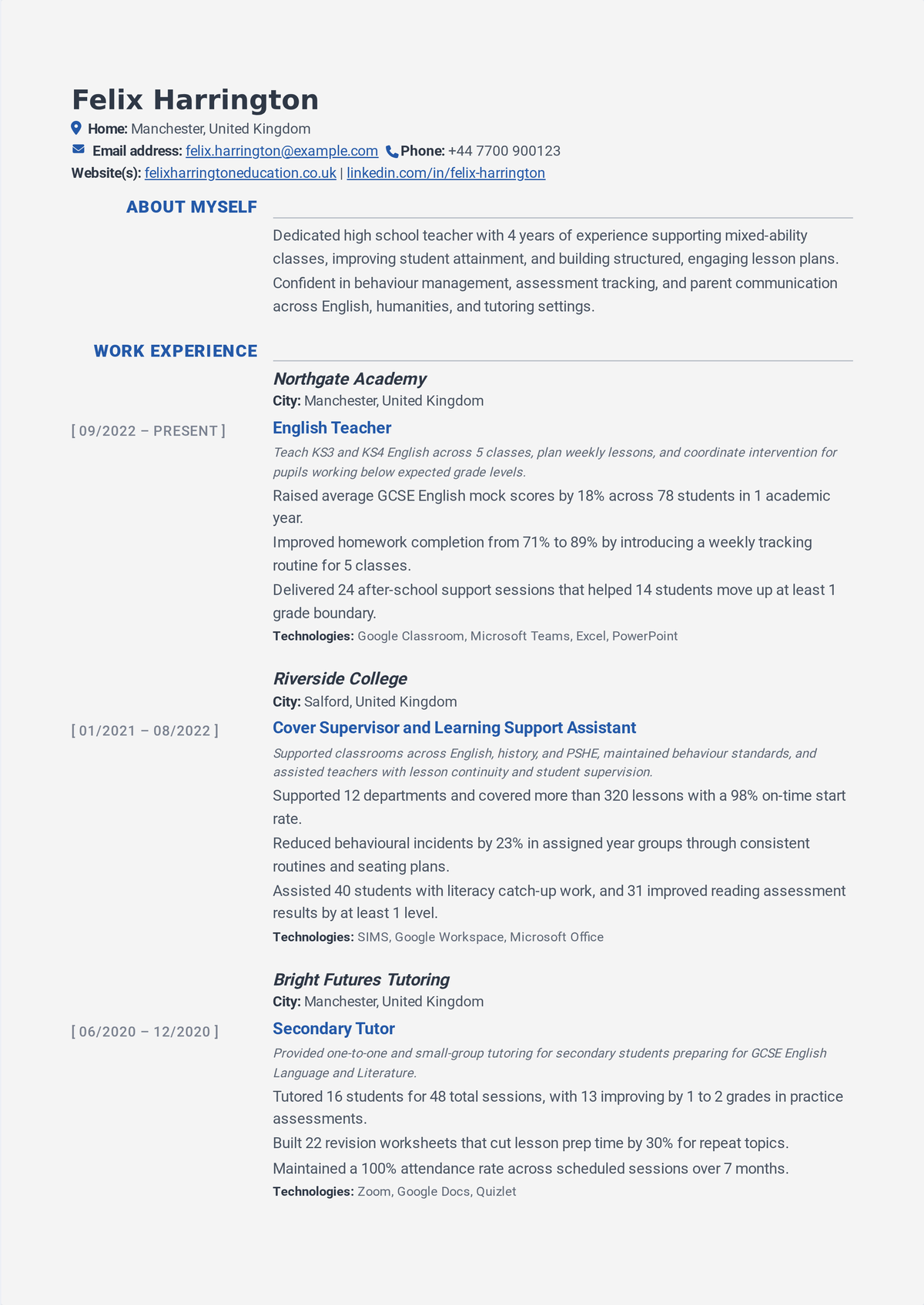
Why this resume works
- It leads with the subject certification, then spends the page on outcomes: mock-exam gains, homework-completion jumps, and grade-boundary moves.
- It quantifies breadth as well as depth, naming the number of classes, students, and support sessions delivered across a year.
- It shows the mid-career signal principals look for: covering departments, mentoring, and running intervention rather than only teaching a timetable.
- It stays ATS-clean, with standard headings and real keywords and no columns or graphics to garble the parse.
ESL / English language teacher (mid-career)
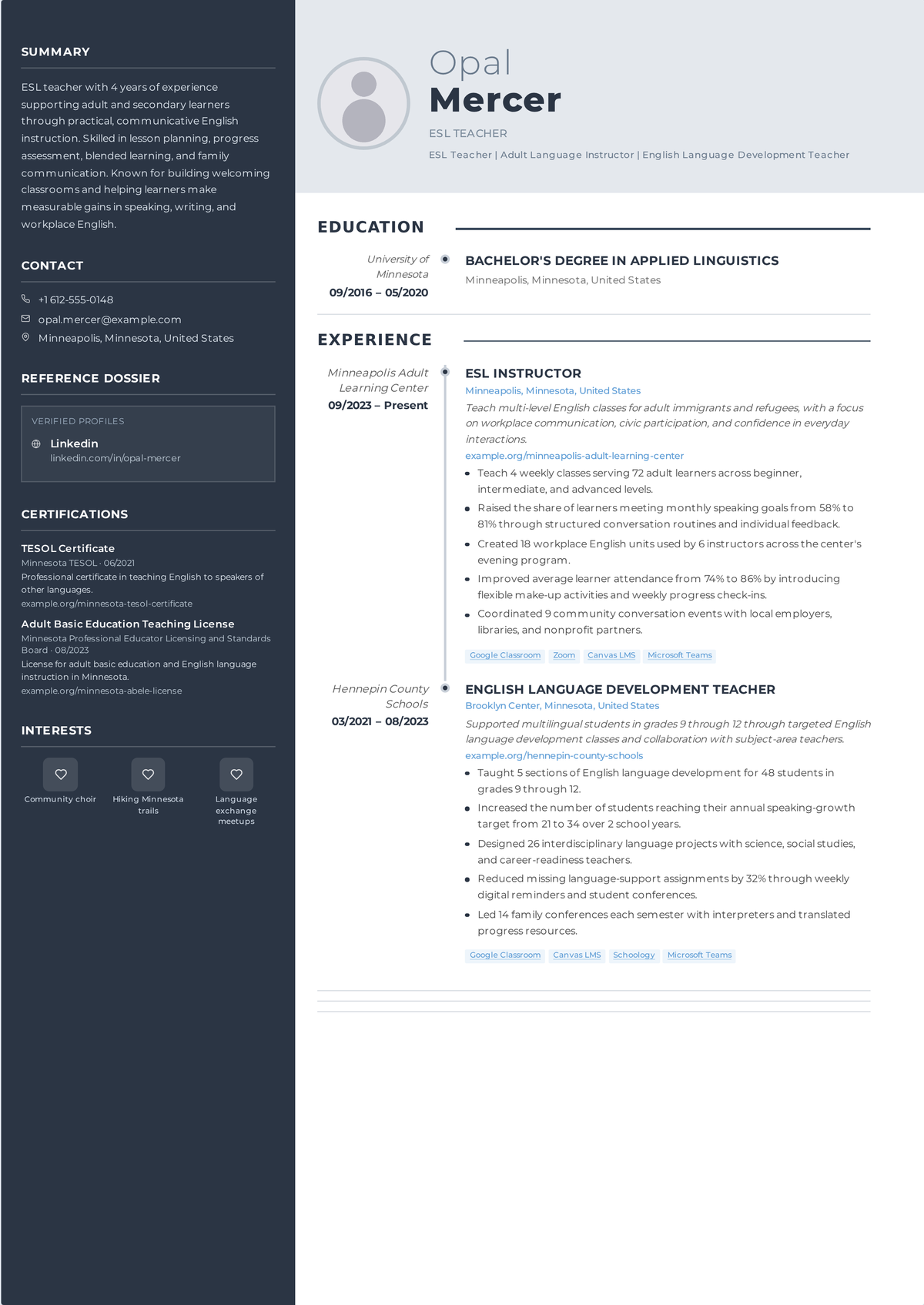
An ESL or English-language teacher works across the grades a school serves, pulling small groups and pushing into mainstream classes to move multilingual learners toward proficiency. This resume leads with the ESL or TESOL endorsement, then shows the work that defines the role: assessing English-language proficiency, differentiating the same lesson for a beginner and a near-fluent student in one group, coordinating accommodations with classroom teachers, and tracking how fast students climb the proficiency levels. The numbers here are proficiency-level gains and reclassification rates, not one class's test average.
Why this resume works
- The ESL or TESOL endorsement leads the page, the credential a language-program posting screens for first.
- It quantifies the outcome that defines the role: students moved up a proficiency level and reclassified as fluent, in real percentages.
- It shows the collaboration the job runs on — push-in and pull-out support, co-planning with grade-level teachers, and family communication across languages.
- It names the frameworks a district scans for: WIDA and ACCESS levels, language-proficiency assessment, and sheltered-instruction methods like SIOP.
Special education teacher (mid-career)
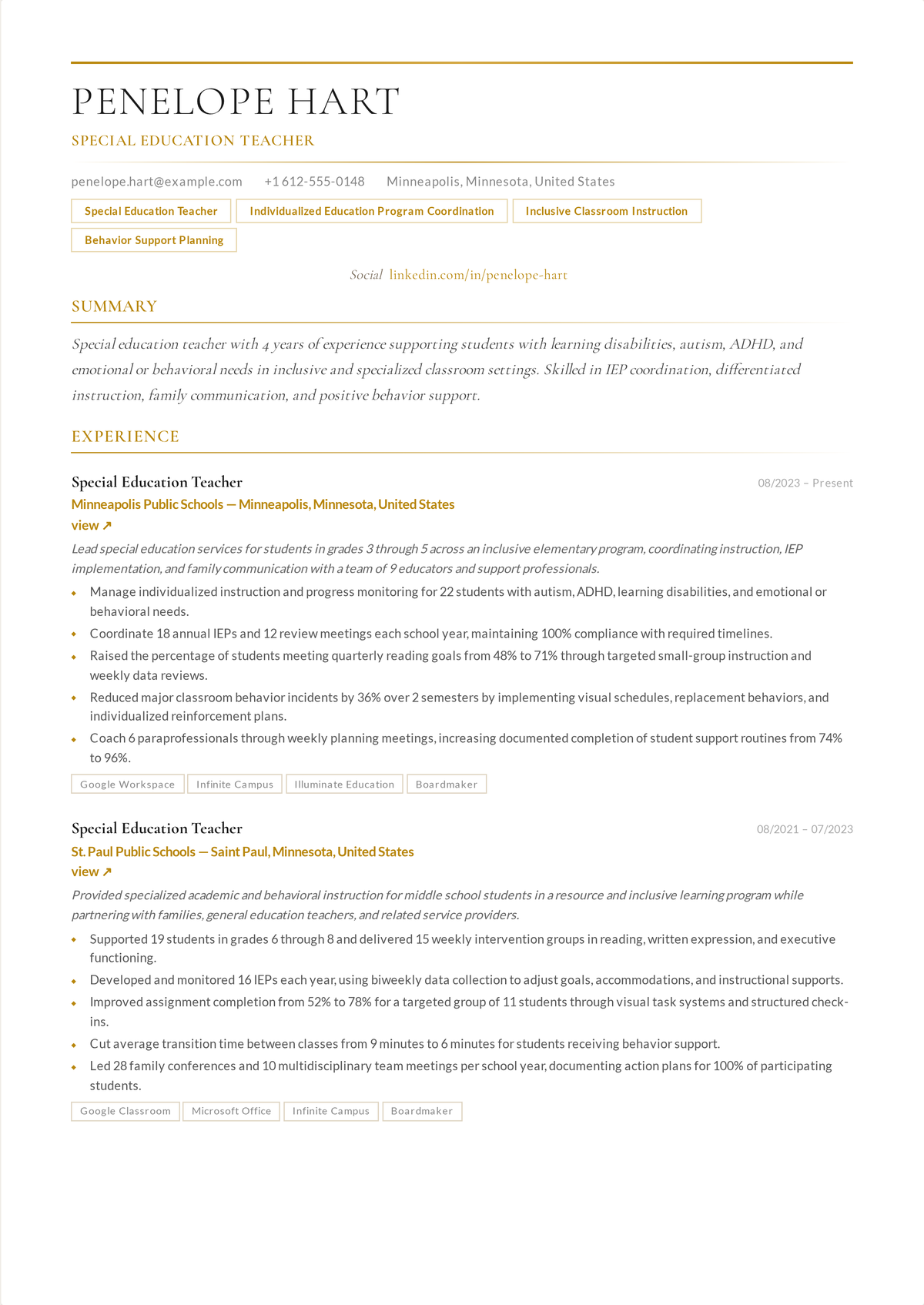
Special education is its own discipline, and this resume reads differently on purpose. It centers IEPs — writing them, leading the meetings, and hitting the goals inside them — alongside co-teaching in inclusion settings, behavior intervention plans, and the daily coordination with therapists, families, and general-education colleagues that the role runs on. Compliance belongs here too: knowing IDEA and documenting accommodations correctly is part of the job, and the resume should say so plainly.
Why this resume works
- It puts the special-education license and IEP work up top, with 100% compliance on required timelines stated as a number.
- It leads with the outcomes that define the role: reading-goal gains, a measurable drop in behavior incidents, and completion rates that rose.
- It shows collaboration explicitly: coaching paraprofessionals, running multidisciplinary meetings, and partnering with families.
- It names the specific tools and frameworks a SPED posting screens for, from IEPs and UDL to assistive technology and behavior plans.
University lecturer (senior)
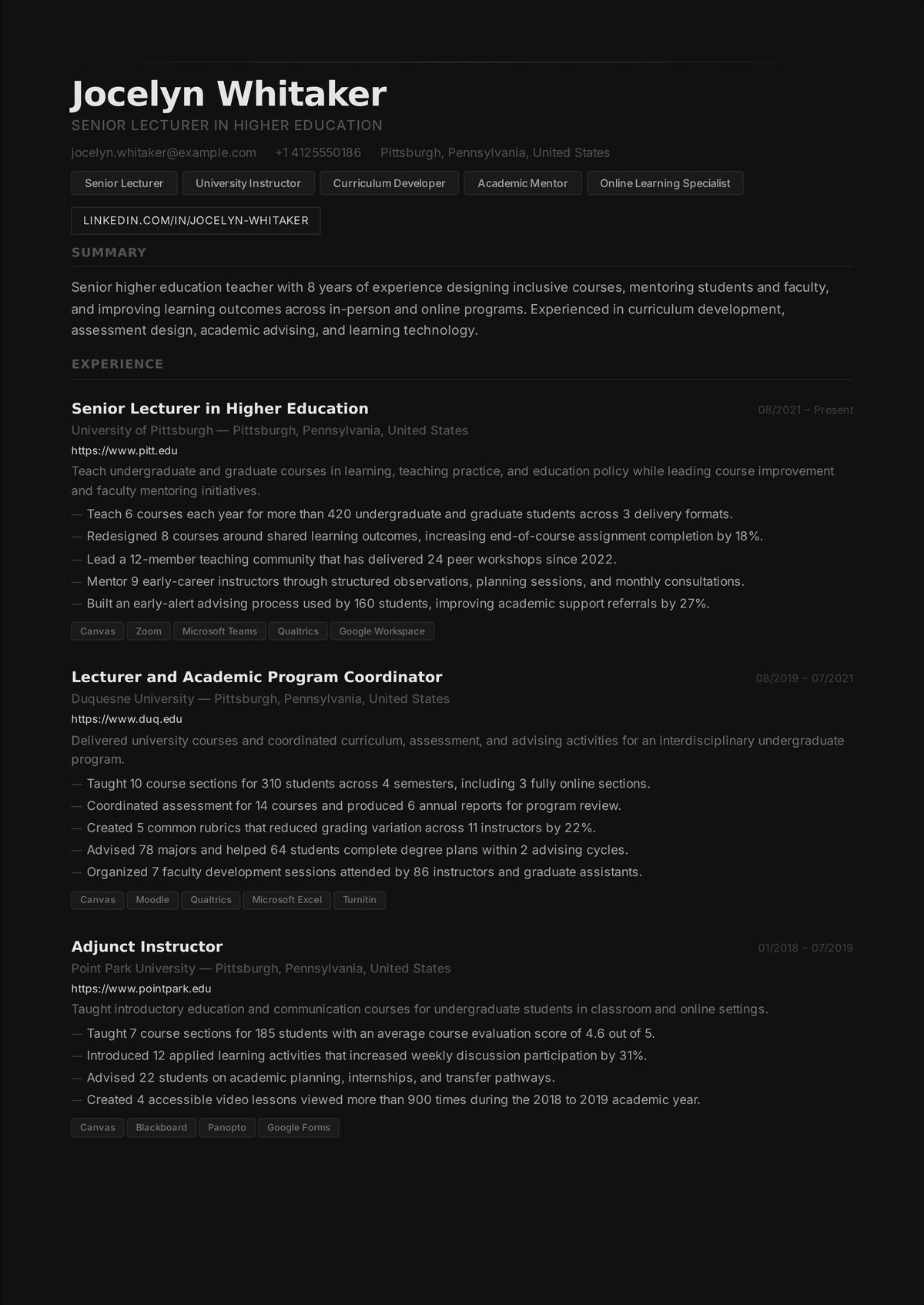
At the university level the document becomes closer to an academic CV than a one-page resume. Research and teaching share the top: publications, courses designed and taught at degree level, thesis and dissertation supervision, conference talks, and grant funding. Teaching evaluations and course pass rates carry the teaching side; a publication list carries the research side. If that's your path, our academic CV guide covers the long-form version in full.
Why this resume works
- It frames the role at university scale: courses taught, delivery formats, and hundreds of students a year, not a single classroom.
- It balances teaching with the work that earns promotion: curriculum design, assessment, advising, and faculty mentoring.
- Every claim is measured, from pass-rate and completion gains to peer workshops delivered and advisees guided through degree plans.
- It reads as senior without padding: four roles over several years, each with larger, documented impact.
Not every teaching resume is for a lead-classroom job. Two more roles round out the picture — the flexible and support positions that many teaching careers start from, and that schools hire for constantly.
Substitute teacher
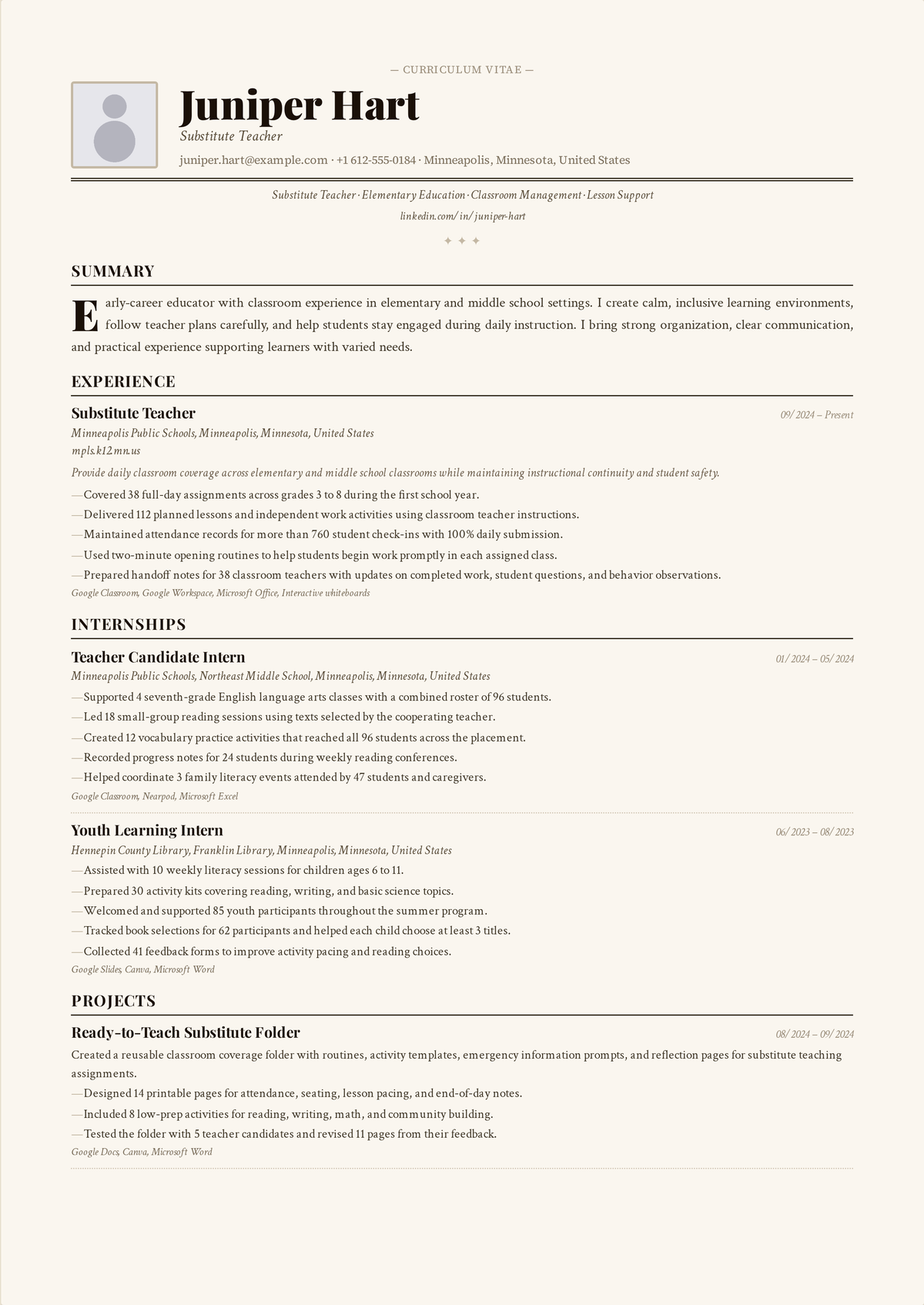
A substitute teacher's resume has a different job from a classroom teacher's: it has to say, quickly, that you can walk into any room and keep learning on track. This one leads with reliability and range — the grade bands and subjects you cover, the districts you're on call for, and the classroom-management skills that matter most when you don't know the students yet. It leans on breadth over depth: many schools, many grades, and a track record of being asked back.
Why this resume works
- It leads with the substitute credential or permit and the grade bands and subjects covered, so a scheduler sees the fit in one line.
- It sells reliability with numbers — schools served, days worked, and request-back rates that prove dependability.
- It foregrounds classroom management and following a lesson plan cold, the skills that matter most when you don't know the students.
- It stays ATS-clean and keyword-matched, using the district's own terms for coverage, certification, and grade levels.
Teaching assistant / paraprofessional (entry level)
A teaching assistant or paraprofessional supports a lead teacher and, often, specific students — so this resume shows how you make a classroom run: small-group and one-on-one support, help with IEP accommodations, behavior support, and the daily logistics that free the teacher to teach. For many people it's a first step toward a full teaching license, so the resume also signals the coursework or certification in progress.
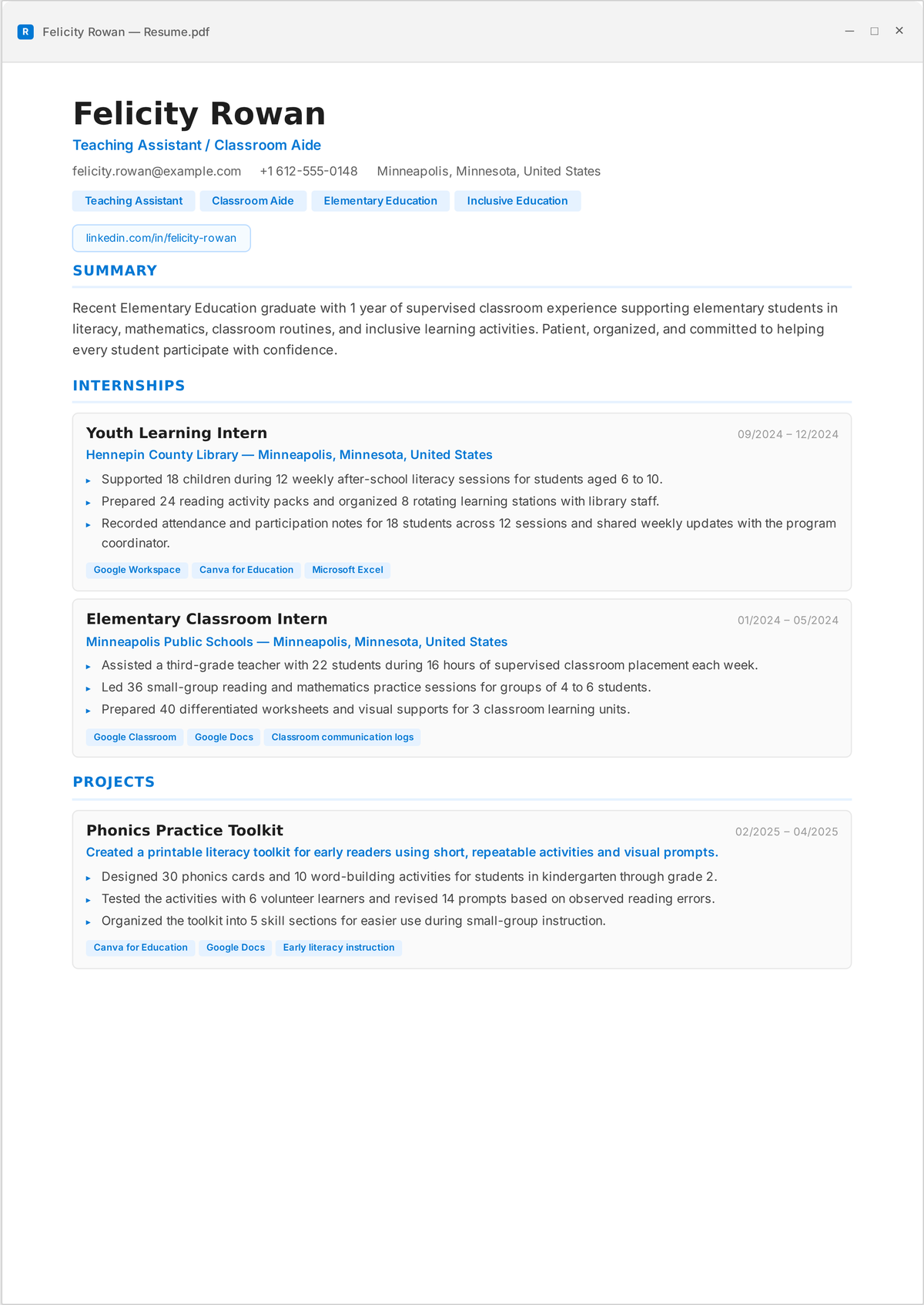
Why this resume works
- It names the paraprofessional credential (or ParaPro assessment) and any certification in progress, the gate many districts check first.
- It shows the support work concretely: small-group instruction, one-on-one help, and IEP accommodations delivered under a lead teacher's plan.
- It backs the role with numbers — students supported, reading or behavior gains, and hours of documented one-on-one time.
- It reads as a step on a path: relevant coursework and an expected teaching certification signal where the career is going.
A teacher resume template you can copy
Here is a complete elementary-teacher resume in plain text — single column, standard headings, real numbers. It's a template in the practical sense: swap in your own certification, school, and results, and you have a resume a parser can read and a principal can scan in seconds.
Rachel Nguyen
Austin, TX · rachel.nguyen@email.com · (512) 555-0148 · linkedin.com/in/rachel-nguyen
Summary
Texas-certified elementary teacher (EC–6) with five years teaching 3rd and 4th grade in Title I schools. Raised the share of students reading on grade level from 61% to 84% across two years through daily guided-reading groups and data-driven small-group instruction. Seeking to bring the same results-focused literacy work to Eanes ISD.
Certifications & licensure
Texas Core Subjects EC–6 (Cert. #1234567), valid through 2028 · ESL Supplemental Certification · CPR / First Aid certified
Experience
4th Grade Teacher — Blackshear Elementary, Austin ISD (2021–present)
- Raised on-grade-level reading from 61% to 84% of a 24-student class over two years using leveled guided-reading groups and biweekly running records.
- Designed a cross-curricular science-and-writing unit that the whole 4th-grade team adopted the following year.
- Cut chronic behavior referrals by half after introducing a class-wide routines-and-rewards system.
- Mentored a first-year teacher through her induction year, co-planning weekly.
3rd Grade Teacher — Blackshear Elementary, Austin ISD (2019–2021)
- Taught all core subjects to a class of 22; 88% met or exceeded the state STAAR reading standard in 2021, up from 70% the year before.
- Kept a weekly parent-communication log and translated key notices into Spanish for a bilingual community.
Student Teaching — Pickle Elementary, Austin ISD (Spring 2019)
- Led daily math and reading blocks under a mentor teacher for a 2nd-grade class of 20.
Education
BS in Interdisciplinary Studies (EC–6), University of Texas at Austin — 2015–2019
Skills
Guided reading · Differentiated instruction · Small-group and data-driven instruction · Classroom management · STAAR preparation · Google Classroom · Seesaw · Parent communication (English/Spanish)
Languages
English (native) · Spanish (conversational)
What makes this one work: the certification sits directly under the summary with its exact name and expiry, every experience bullet carries a number a principal could verify, and the two roles at the same school are stacked to show a promotion in place. The layout is deliberately plain so an applicant tracking system extracts each field cleanly.
List the license in full: exact certificate name, state, grade or subject endorsement, and expiration date — "Texas Core Subjects EC–6, valid through 2028." That's what tells a principal the license is current. Add the certificate number only when an application specifically asks for it: it's a sensitive ID, and a resume gets uploaded to job boards and forwarded around, so there's no reason to publish it by default.
The skills to put on a teacher resume
Teaching skills fall into a handful of areas that districts screen for by name. List the ones the posting actually asks for, in its own words, and back the important ones with a bullet in your experience section rather than leaving them as a bare list.
| Skill area | What to put on the resume |
|---|---|
| Classroom management | Routines, behavior systems, referral reductions, restorative practices |
| Differentiated instruction | Tiered and small-group lessons, scaffolding, gifted and struggling learners in one room |
| Assessment & data | Formative assessment, running records, standardized-test prep, using data to regroup students |
| IEPs & accommodations | Writing and implementing IEPs and 504 plans, co-teaching, IDEA compliance |
| EdTech | Google Classroom, Seesaw, Canvas, smartboards, learning-management systems |
| Curriculum design | Unit and lesson planning to state standards, cross-curricular units, pacing guides |
| Family communication | Parent conferences, newsletters, translation, positive-contact logs |
Skip skill bars and star ratings. A screening tool reads "four stars in classroom management" as nothing, and a principal reads it as filler. A short, honest list of named skills plus one bullet that shows the skill in action does more than any graphic.
How to write each section of a teacher resume
Put certification and licensure first
In most of the country a teaching job has a hard gate: the right state license for the right grade band and subject. A principal, and the applicant tracking system in front of the principal, checks that before anything else, so give it a Certifications and Licensure section directly under your summary. List the exact certificate name, the state, the grade band or subject endorsement, and the expiration date — "Texas Core Subjects EC–6, valid through 2028." Add supplemental endorsements (ESL, bilingual, gifted) and CPR/First Aid on the same line. If you're certified in more than one state, say so; if your certification is still pending, write "Texas EC–6 certification expected June 2026" rather than leaving it off — a pending license is a very different thing from no license.
Turn duties into numbers
"Taught reading to 3rd graders" describes a job. "Raised on-grade-level reading from 61% to 84% across two years" describes a teacher worth hiring. Teaching produces measurable results, and a resume that names them stands out in a stack that mostly doesn't. The numbers that carry weight: test-score or reading-level gains, the share of a class meeting standards, attendance and behavior improvements, class size and student load, and IEP-goal attainment for special-education roles. Pull them from your own gradebook and state score reports, and only claim what you can defend in an interview — "how did you get that number?" is the obvious follow-up.
Before: Responsible for teaching math to elementary students. After: Taught daily math to a class of 24; 82% met the state standard, up 14 points from the previous year.
Before: Helped students with special needs. After: Wrote and managed 12 IEPs, led each annual review meeting, and hit 90% of documented goals on schedule.
Write a summary that names your grade band and one result
Two or three sentences at the top: your certification and grade band, your years of experience, and the single strongest result you can point to. "Texas-certified elementary teacher (EC–6) with five years in Title I schools; raised on-grade-level reading by 23 points" tells a principal more than a paragraph about your passion for children. Name the district or school you're applying to when you can — it signals you tailored the resume for them rather than sending the same file everywhere. Skip an objective statement about what you hope to gain; the summary describes what the school gets.
Use the keywords the posting and the ATS scan for
Public-school districts and many private schools run applications through an applicant tracking system that parses your resume and matches it against the posting. Systems vary — some knock out a missing must-have, many just rank or flag candidates for a recruiter — but a parser-safe file written in the posting's own words gives you the best odds either way. Reuse the posting's exact language where it's honest: if it says "differentiated instruction," "IEP," "PLC," or "STAAR," use those terms rather than synonyms. Keep the layout parser-safe — single column, standard headings (Experience, Education, Certifications, Skills), a real-text PDF, no photo, no graphics boxing in your history. You can check what a parser actually pulls from your file with Prezumi's free ATS resume checker, and the ATS-friendly templates start you from a layout that already passes. The full rules on ATS parsing are in our resume writing guide.
Teacher salary insights
Pay in teaching is set mostly by district salary schedules, which key off your degree, certification, and years of service rather than negotiation. The ranges below are illustrative U.S. figures meant to show how compensation shifts by level and specialization; your actual figure depends on state, district, and step on the schedule. For current national medians by role, the U.S. Bureau of Labor Statistics Occupational Outlook Handbook is the citable source.
| Teaching role | Typical U.S. salary range (illustrative) |
|---|---|
| Preschool / early-childhood teacher | $35,000–$52,000 |
| Elementary (K–5) teacher | $45,000–$68,000 |
| Middle / secondary subject teacher | $48,000–$72,000 |
| Special education teacher | $50,000–$74,000 |
| High-school STEM / AP teacher | $52,000–$80,000 |
| University lecturer / instructor | $58,000–$95,000+ |
Two things move these numbers within a district: extra duties and extra credentials. Coaching a sport, running a club, or leading a grade-level team usually adds a stipend, and National Board Certification or a master's degree bumps you up the salary schedule for good. It's worth putting both on the resume — a board certification is a credential a principal recognizes on sight, and a stipended leadership role shows you take on more than your own classroom.
Build your teacher resume in Prezumi
Prezumi holds your teaching history as one profile and renders it into any of 55+ templates, so you write the certifications, the results, and the skills once. Import an existing resume to skip retyping, pick an ATS-friendly template that keeps a clean single column, and export a text-based PDF for free. When you apply to a specific district, the AI editor rewords your real entries to match that posting (it can only reshape the details you entered, so it won't invent a test score), and the ATS checker confirms the file parses before you send it. If you're moving into teaching from another field, or writing your first resume straight out of a teaching program, our first-job resume guide shows how to fill a resume with student teaching, practicums, and coursework instead of years on the job. Still completing your teacher-training degree? The student CV examples use the same one-page approach, and if you graduated with academic honors, our summa cum laude guide shows exactly where that line goes on the page.
FAQ
Do I list my teaching license on a resume?
Yes, and near the top. A teaching job is gated on holding the correct state license for the grade band and subject, so a Certifications and Licensure section belongs directly under your summary. List the exact certificate name, the state, the grade or subject endorsement, and the expiration date, then add supplemental endorsements like ESL or bilingual and your CPR/First Aid status. Add the certificate number only if the application asks for it — it's a sensitive ID that doesn't belong on a document you upload to job boards.
Should a teacher resume include a photo?
No, for jobs in the US, UK, Canada, and most of Europe. Districts don't need a photo, many actively prefer applications without one to avoid bias, and a photo can trip up an applicant tracking system. A few countries do expect a photo on any CV; follow local convention if you're applying somewhere that clearly asks for one, but leave it off by default.
How do I write a teacher resume with no experience or only student teaching?
Treat student teaching, practicums, and observations as your experience section, because that is exactly what they are. Give each placement a real entry with the school, grade, dates, and bullets that carry numbers — class size, subjects taught, a lesson or unit you led, any result you can point to. Add coursework relevant to the role, your certification (or its expected date), and classroom-adjacent work like tutoring, camp counseling, or coaching. Our first-job resume guide walks through filling a resume when you don't have years of paid work yet.
How is an elementary teacher resume different from a secondary one?
An elementary resume shows range across every subject for one class — guided reading, math, science, differentiated instruction, and classroom management for young children. A secondary resume shows depth in one subject across many students, so it foregrounds a single-subject certification, planning to state standards, grading at volume, and managing a roster of 120-plus teenagers. The certification differs too: elementary teachers usually hold a broad grade-band license, while secondary teachers hold a subject-specific one.
How long should a teacher resume be?
One page for most teachers, including new graduates and those with less than roughly ten years of experience. Two pages are justified when a decade or more of directly relevant teaching, leadership, and results genuinely fills them. University-level roles are the exception: they use a longer academic CV that lists publications, courses taught, supervision, and grants in full, and those documents run to several pages by design.
How do I show classroom impact with numbers?
Pull results from your own gradebook and state score reports and put them in your experience bullets. The numbers that carry weight are test-score or reading-level gains, the share of a class meeting grade-level standards, attendance and behavior improvements, class size and student load, and IEP-goal attainment for special-education roles. Write the before-and-after where you can — "raised on-grade-level reading from 61% to 84% over two years" — and only claim figures you can explain in an interview.
What skills should I put on a teacher resume?
The ones the posting names, in its own words. The core set most districts screen for is classroom management, differentiated instruction, assessment and data use, curriculum and lesson planning, EdTech tools like Google Classroom and Seesaw, and family communication. Special-education roles add IEPs, 504 plans, co-teaching, and IDEA compliance. Back the important skills with a bullet that shows them in action rather than leaving them as a bare list, and skip skill bars and star ratings.
Should a teacher resume have an objective or a summary?
A summary. Two or three sentences naming your certification and grade band, your years of experience, and your single strongest result outperform an objective statement about what you hope to gain. The summary describes what the school gets by hiring you, which is what a principal is scanning for in the first few seconds. Name the district you're applying to when you can, so it reads as tailored rather than generic.
Do I still need a certifications section if my degree already covers it?
Yes. A degree and a teaching license are separate things, and a principal needs to see the current license, its grade or subject endorsement, and its expiration date — a degree alone doesn't confirm you're cleared to teach this year. Keep the certification section even if your bachelor's or master's is in education; list the license explicitly with its state and endorsement, and note any supplemental certifications separately.
How do I make my teacher resume ATS-friendly?
Use a single-column layout, standard section headings (Experience, Education, Certifications, Skills), and a PDF that contains real extractable text rather than an image. Reuse the exact keywords from the job posting where they honestly apply, and leave out photos, columns, and graphics that box in your history, since those scramble parsing. Prezumi's free ATS resume checker runs real text extraction on your file and shows you what a parser pulls out, so you can confirm it reads cleanly before you send it.
Can I put student test scores or results on my teacher resume?
Yes, as aggregate results, never identifiable student data. Write class- or cohort-level numbers you can defend — "raised on-grade-level reading from 61% to 84% across a 24-student class" or "82% of the class met the state standard, up 14 points." Never name a student, an IEP holder's details, or anything that could identify a child; that breaks confidentiality (FERPA in the US) and reads as a red flag to a principal. Pull the figures from your own gradebook and state score reports, and only claim what you can explain in an interview.
How do I list an out-of-state or international teaching license?
State exactly where the license is valid and its current status. For another U.S. state, list the license as-is and add "reciprocity application in progress for [state]" if you've started one — most states have a reciprocity route, and showing you know it reassures a principal. For an international qualification, name the country, the equivalent grade band, and any credential evaluation you've completed. If you're not yet certified in the hiring state, say so plainly with an expected date — a clear pending status beats a vague one.
Do I need a teaching portfolio or LinkedIn link on the resume?
A link, not the whole thing. A teaching portfolio — lesson plans, student work samples, observation write-ups — is worth one line pointing to it (a URL, or "portfolio available on request"), especially early in your career when work history is thin. LinkedIn is optional but low-cost: include it if the profile is current and matches the resume. Don't paste long file lists into the resume itself; keep it to one or two clean pages and let the link carry the depth.