How to Write a CV for Your First Job — With Examples, No Experience Needed
How to write a CV for your first job with no work experience: what goes in each section, three example summaries, and six before/after bullet rewrites.
Canonical: https://qa.prezumi.com/blog/first-job-cv-no-experience
A CV for your first job is built from a handful of sections: a header with your name, phone, email, and city; a two-to-three-sentence summary that names the role you want and your strongest evidence you can do it; an education section placed near the top; a skills list that mirrors the wording of the job ad; and an experience section built from things that were never paid jobs, like volunteering, coursework projects, sports teams, clubs, or an online community you moderate. When work history can't fill the page, a few more sections earn their place and do real work: certifications, short courses, languages, and a tight list of interests. Nobody reading a first-job CV expects employment history. They expect evidence that you show up, finish things, and can be trusted with responsibility.
The blank experience section feels like the problem, but it usually isn't. If you have organised anything, helped anyone, built anything, or kept a commitment going for months, you have material. The real work is translation: "I helped at a charity event" becomes "coordinated a 12-volunteer team at an event that raised €3,000". It is the same fact, told in the language employers actually hire in. This guide goes section by section, with three full example summaries and six before-and-after bullets you can copy the pattern from. If you're still in education, our student CV examples walk through three full annotated CVs for the same situation, and if you want the general rules that apply to every CV before the first-job specifics, the resume writing guide covers those.
What a first-time employer is actually looking for
No employer expects a first-time hire to arrive knowing the job. Employer surveys keep confirming this: the competencies in NACE's career-readiness framework, which US employers helped define, are things like professionalism, communication, and teamwork rather than job-specific expertise. In practice they're hiring for four things, and every section of your CV is a chance to evidence one of them:
- Reliability — you turn up, on time, when you said you would. A year of Saturday volunteering proves this better than the word "reliable" ever could.
- Trainability — you can be taught and you want to learn. A free online course or a new skill picked up for a project shows it.
- Initiative — you do things without being told. Anything you started — a club, a fundraiser, a side project — counts.
- Communication — you can talk to people and work in a team. Tutoring, presentations, captaining a side, or any customer-facing role demonstrates it.
Keep these four in mind as you write. Every bullet should quietly answer one of them.
Build it section by section
Here is the whole structure at a glance. The rest of this section walks through each row in detail.
| Section | What goes in it | First-CV notes |
|---|---|---|
| Header | Name, phone, sensible email, town or city | Skip the photo, date of birth, and full street address |
| Summary | 2–3 sentences: target role, strongest credential, one achievement with a number | Rewrite it for every application |
| Education | School or university, qualification, dates, relevant subjects | Goes above experience on a first CV |
| Experience | Volunteering, projects, clubs, teams, community and caring roles | Title it "Experience" — "Work Experience" promises jobs the section won't contain |
| Skills | Hard and soft skills in the job ad's exact wording | No skill bars or star ratings; ATS software can't read them |
| Certifications & courses | First aid, food hygiene, driving licence, free online courses | Often what fills a thin page with verifiable signal |
| Languages | Each language with an honest level | A genuine differentiator for customer-facing roles |
| Interests | Two or three specific ones, like a team captaincy or a website you built | Cut generic filler such as "reading, music, socialising" |
The header
Name, phone number, a sensible email address, and your town or city. That covers it. If your email address dates from when you were thirteen, make a new one in the name.surname format before you apply anywhere. Skip the photo, date of birth, and full street address — recruiters don't need them, and in many countries they would rather not receive them for legal reasons: US anti-discrimination law, for example, restricts what employers may ask about or consider, including age and other personal characteristics. Add a LinkedIn URL only if the profile is filled in.
Put education first
A standard CV leads with work experience. A first-job CV flips the order, because education is your strongest verified credential right now. List your school or university, your qualification, and the dates. Add two or three relevant subjects or modules if they connect to the job, and your grades if they help you — and if you graduated with honours like summa cum laude, list those too. If they don't help you, leave them out; you are under no obligation to volunteer bad news.
The summary, with three examples
Recruiters spend roughly seven seconds on a first scan, a figure cited so often in the industry it has become furniture. Your summary is what those seconds land on, so make it three sentences: who you are, what you're applying for, and the most concrete evidence you have. Here are three that work for different lives.
Fresh graduate applying for a marketing role:
Business graduate (2:1, University of Leeds) applying for the Marketing Assistant role at Hartley & Co. I ran social media for the university film society for two years, growing its Instagram from 300 to 2,100 followers, and wrote my dissertation on consumer behaviour in subscription services. Comfortable with Canva, Google Analytics, and deadlines that don't move.
School leaver applying for a first retail job:
Reliable school leaver looking for a weekend sales assistant position. I handled the till and stock at my school's charity shop pop-up for two terms and have volunteered every Saturday morning at a local food bank for over a year, so early starts and busy counters are familiar territory. Teachers and shift leads describe me as the person who stays calm when the queue doesn't.
Adult entering the formal workforce for the first time:
Organised and dependable applicant for the Administrative Assistant role at Westfield Clinic, moving into office work after eight years running a busy household and serving as treasurer of a 200-family school parents' association. I track budgets in Excel, chase late payments politely but persistently, and have chaired committee meetings that finished on time. I'm looking for an employer who values someone with that kind of patience.
Notice what all three do: a specific role, a specific number, and one detail that sounds like a human wrote it. None of them apologise for the missing job history, and none of them mention it.
The experience section you didn't know you had
Call it "Experience" or "Relevant Experience" — never "Work Experience", because that title promises something the section won't contain. Then list anything where you did real work for real people: volunteering, group coursework, a club you ran, a team you played on, a family business you helped in, a Discord server you moderate. Each entry gets a role-style heading (what you did, where, when) and one to three bullets.
The bullet formula is action verb, then what you did, then a number that proves scale or outcome. If a bullet has no number, ask yourself how many, how often, or how big, and one usually appears. If rephrasing is the part you get stuck on, Prezumi's AI editor rewrites bullets grounded in the profile data you actually entered, which means it sharpens what you did rather than inventing a job you never had. Tempted to hand the whole thing to ChatGPT instead? Read where that works and where it backfires first, because invented experience is the one mistake a first interview always exposes.
Skills
Read the job ad, list the skills it asks for that you genuinely have, and use the ad's exact wording. This matters because most employers screen applications with ATS software before a human reads them — Harvard Business School's Hidden Workers study found that over 90% of the employers it surveyed use such systems to filter or rank candidates — and that software matches exact words, so a synonym can cost you a match the human reviewer would have given you. Separate hard skills (Excel, Python, a second language, a forklift licence) from soft ones (teamwork, time management), and never use skill bars or star ratings, because a machine reads "four out of five stars in communication" as nothing at all.
Certifications, courses, languages, and interests
These are the sections most first-job CVs leave off, and they are exactly the ones that fill a thin page with real signal. Each one answers a question an employer is asking about someone with no work history: are you the kind of person who learns things on their own, and are you safe to put in front of customers?
Certifications. A first-aid certificate, a food hygiene certificate, a driving licence, or a free online course (Google Digital Garage, HubSpot, freeCodeCamp, a LinkedIn Learning course) all belong here. They are cheap or free, take a weekend, and prove you go and get qualifications without being told to. List the title, the issuer, and the year: "Level 2 Food Safety & Hygiene, High Speed Training, 2025." For a retail or hospitality job, a food hygiene certificate can be the line that gets you the interview.
Relevant courses. If your A-levels, GCSEs, or degree included something that maps to the job, name it. A "Young Enterprise" programme, a business studies module, a coding short course, or an extended project all show you have touched the work before.
Languages. List any second language with an honest level — native, fluent, conversational, or the GCSE grade. For customer-facing and international roles this is a genuine differentiator, and it is the easiest section to under-sell.
Interests. Keep this short and make every line carry weight. "Captain of the school football team" signals leadership and commitment; "built a personal website" signals initiative. Skip the generic "reading, music, socialising" that says nothing. Two or three specific interests are worth more than a long list of filler.
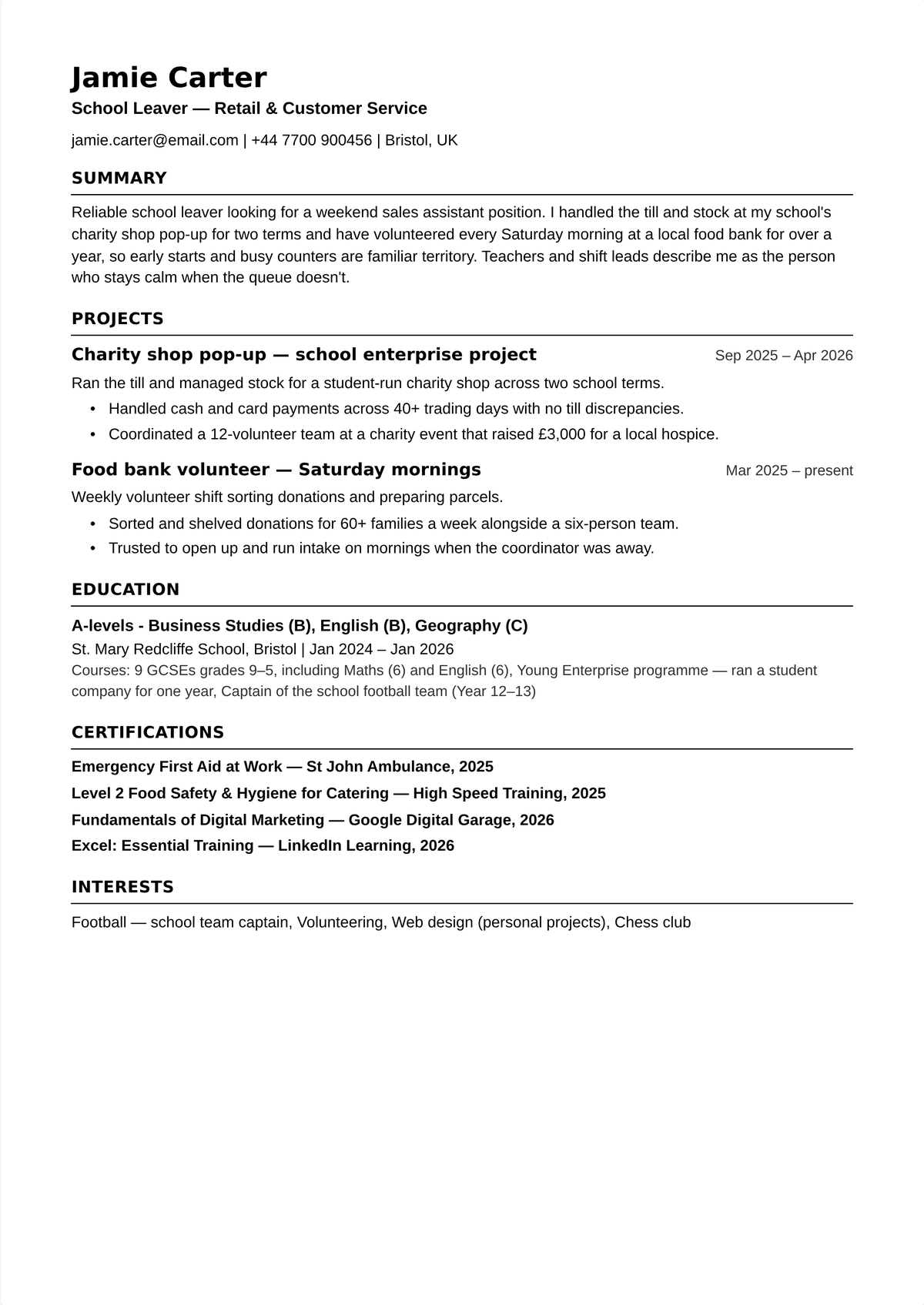
Here is what a finished first-job CV looks like with no employment history at all. The school leaver below has zero paid jobs, yet the page is full: volunteering and a school enterprise project stand in for work experience, and certifications, a Young Enterprise programme, a second language, and a short interests list carry the rest.
Six bullets, before and after
These rewrites are the whole trick. Each pair takes a true but invisible sentence and gives it a verb, a scope, and a number.
Before: Helped at a charity event. After: Coordinated a 12-volunteer team at a charity event that raised €3,000 for a local hospice.
Before: Babysat for neighbours. After: Provided regular evening childcare for three families over two years, managing meals, bedtimes, and homework for children aged 4 to 10.
Before: Member of the school football team. After: Trained six hours a week with the school football team for three seasons and organised travel logistics for 15 away matches.
Before: Run a Discord server. After: Moderate a 2,400-member gaming Discord, recruiting and training five volunteer moderators and resolving member disputes within house rules.
Before: Did a group project at university. After: Led a four-person coursework team building a budgeting app; delivered on deadline and presented the result to a panel of 30 students and staff.
Before: Helped in my parents' shop. After: Handled cash, stock counts, and customer questions in a family-run shop during weekend rushes of 100+ customers.
Every "after" version describes the same life as the "before" version. The difference is that the second one answers the question the employer is silently asking: what happens if I give this person responsibility?
Common mistakes on a first CV
Padding with adjectives. "Hardworking, motivated team player" tells an employer nothing they can verify. One concrete bullet beats ten adjectives, and a recruiter can smell the difference from across the room.
Writing about what you want. A summary that opens with "Seeking a position where I can grow" describes your goals, and the employer is shopping for theirs. Lead with what they get.
Stretching to two pages. A first-job CV should be one page. Some white space is fine, and a padded second page reads as exactly what it is.
Choosing a decorative template. Heavy graphics, text boxes, and two-column layouts can scramble the text order that ATS software extracts, so your carefully written bullets arrive as word salad. Use a layout that machines read cleanly — Prezumi's ATS-friendly templates are tested with real text extraction, and you can run any finished CV through the free ATS resume checker to see exactly what software pulls out of your PDF before an employer's system does.
Inventing experience. A first interview is mostly questions about your CV, and a fictional charity role collapses under the second follow-up question. Translate what you actually did as generously as the truth allows, and stop there.
Sending one CV everywhere. The skills section and summary should shift with every application, because the ad's wording shifts. It takes ten minutes and it is the cheapest advantage available to you.
First-job roles this CV works for
The structure here — education near the top, an experience section built from unpaid work, one clean page — is what's expected for nearly every entry-level role. It works as written for a retail or sales assistant, waiter, barista, or kitchen porter; a care or support worker; a receptionist, admin, or data-entry role; a call-centre or customer-service job; a warehouse, delivery, or events role; and most apprenticeships and internships. Match the summary line and the skills to the specific ad, keep the rest, and one base CV covers a whole job search. For a first teaching job straight out of a training programme, our teacher resume examples show how student teaching and a pending licence fill the experience section the same way.
FAQ
What do I put on a CV if I have no work experience at all?
Put your education near the top, since it is your strongest verified credential, then build an experience section from unpaid work: volunteering, school or university projects, sports teams, clubs, caring responsibilities, community roles, or online communities you help run. Title that section "Experience" rather than "Work Experience", so the heading doesn't promise jobs it won't contain. Describe every entry with an action verb and a number, in the pattern "organised weekly training for a 20-player squad" — scale and frequency are what turn ordinary activities into evidence. Then fill the rest of the page with the sections most first-time applicants forget: certifications such as first aid, food hygiene, or a free online course from Google or HubSpot; relevant school or university courses; languages with an honest level; and two or three specific interests, like a team captaincy or a website you built. Employers reading a first-job CV want evidence of reliability and initiative, and every one of those sections can supply it.
How long should a CV for a first job be?
One page. Recruiters spend roughly seven seconds on a first scan, so a tight single page with a summary, education, skills, and three or four experience entries puts your strongest material inside those seconds, while a padded second page dilutes it and suggests you couldn't tell what mattered. Some white space is fine — nobody penalises a first CV for breathing room, and an honestly half-filled page reads better than an artificially full one. If the page looks genuinely thin, expand your strongest entries with one extra bullet each rather than inventing weak ones, and add the sections most first-time applicants skip: a certification you earned, a language with an honest level, a free online course you finished, or a short list of specific interests. Each of those fills space with something an employer can verify, which is the only kind of filler that helps an application rather than hurting it.
Do I need a summary on a first-job CV?
Yes. Without work history, the summary is the one place on the page where you control the first impression instead of hoping the reader assembles a good one from thin sections. Keep it to two or three sentences with a fixed job to do: the role you are applying for, named specifically; your education or strongest credential; and one verifiable achievement with a number in it, such as growing a society's Instagram from 300 to 2,100 followers or volunteering every Saturday for over a year. Skip generic openers like "motivated team player seeking an opportunity to grow" — recruiters read them as filler because they usually are, and they describe your goals when the employer is reading for theirs. Rewrite the summary for every application: swap in the role name from the ad, and swap the evidence to whatever best matches that specific job. It takes five minutes and it is the cheapest advantage available on a first-job CV.
Are CV templates okay for a first job?
Yes, as long as the template is machine-readable. Most mid-size and large employers run CVs through ATS software before a person sees them, and that software struggles with heavy graphics, text boxes, and unusual layouts. Pick a clean single-column or extraction-tested design, then check the result by running the PDF through a free ATS checker to confirm the text comes out in the right order.
What skills should I put on a first-job CV with no experience?
List skills you can actually evidence, in the exact wording the job ad uses — ATS screening software matches literal terms, so writing "customer care" when the ad says "customer service" can cost you a match a human reviewer would have given you. Pull hard skills from your studies and anything you have genuinely used: Excel or Google Sheets, a second language with an honest level, a driving licence, a food-hygiene or first-aid certificate, a programming language from coursework. Draw soft skills from situations you could describe if asked: reliability from a year of Saturday volunteering, teamwork and deadlines from group projects, communication from tutoring or presentations, cash handling from a school charity shop. Keep hard and soft skills in separate short lists so both scan quickly. Avoid skill bars and star ratings, which extraction software reads as nothing at all, and never list a skill you couldn't answer a follow-up question about in an interview.